
Every summer, for just a few nights after the full moon, one of the ocean’s most remarkable events unfolds: coral reefs spawn.
Colonies that have spent an entire year preparing release tiny bundles of eggs and sperm into the water, each species in near-perfect synchrony. Reefs seem to snow upward as millions of bundles float toward the surface. It’s one of the largest reproductive events on the planet—and one scientists still can’t predict with complete precision. The mystery surrounding coral spawning gives it a magical quality that keeps experiencing one high on many divers’ bucket lists.
In Tela, the coral spawn — like much of the science on the reef — is still a mystery! No one is 100% sure when it happens. This July to August, we hope to change that!
We’re hosting a citizen science expedition to, fingers crossed, witness and document the spawn in Tela.
To supplement the traditional spawning dives, which involve sitting on the bottom of the ocean in the dark for what feels like hours on end, day after day, we’re adding an interesting acoustics layer to the research. For this, we’re welcoming The Seabirds Foundation to Tela as visiting scientists to explore a simple but intriguing question: Can you hear a coral spawn?
The answer, we hope, could eventually help us and other coral researchers better monitor one of the reef’s most important annual events using a simple hydrophone and careful observation.
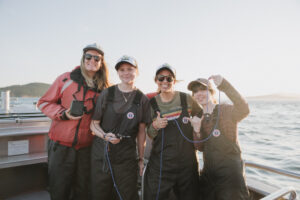
The Seabirds use passive acoustic monitoring to record underwater sound without disturbing marine life. Turns out, healthy coral reefs are surprisingly noisy places. Snapping shrimp create a nearly constant crackling backdrop, while reef fishes add grunts, pops, chirps, and hums that together form a reef’s unique soundscape. Scientists have used these underwater recordings to study reef health, monitor marine life and even better understand where young corals choose to settle.
Coral spawning adds another fascinating layer to that sound story.
Spawning doesn’t just create the next generation of corals—it also becomes one of the ocean’s biggest buffets of the year. As millions of buoyant egg bundles drift through the water column, fish, crustaceans, worms, and countless other reef animals gather to feed. Divers often describe the reef suddenly feeling more alive, with activity increasing in every direction.
If all of that activity changes the reef’s soundscape, could a hydrophone detect it?
That’s what we’ll be working together to find out.
Before the expected spawning window, The Seabirds team will deploy a hydrophone to record the reef’s normal acoustic conditions, creating a baseline for comparison. Then, during nightly spawning surveys under the full moon and the nights that follow, the hydrophone will continue recording while our dive teams watch for the first visual signs of spawning.
By comparing the exact moment divers observe spawning with the acoustic recordings, we’ll look for measurable changes in the reef’s soundscape that coincide with the event. If a consistent pattern emerges, it could suggest that passive acoustic monitoring can complement traditional spawning surveys in the future.
Even if it doesn’t, the recordings themselves will provide valuable baseline data from one of the Caribbean’s most remarkable and resilient coral ecosystems.
For Tela Coral, this collaboration reflects something we deeply believe: conservation moves forward when people bring different skills to the table. The Seabirds have extensive experience using hydrophones to study whales and marine soundscapes. By combining that expertise with Tela Coral’s existing coral restoration and spawning research, we’re able to ask new questions that neither organization could answer alone.
This collaboration brings together two organizations that believe curiosity is one of conservation’s greatest tools.
We don’t know yet if coral spawning has a recognizable soundtrack.
That’s exactly why we’re listening.
This July, while divers keep watch beneath the surface, a hydrophone will be listening alongside them. Whether we uncover a new tool for coral science or simply collect a dataset no one has gathered before, every expedition brings us one step closer to understanding—and protecting—the extraordinary reefs of Tela.