
The Music for the Ocean Japan tour was full of moments we’ll be thinking about for a long time: packed rooms, school visits, student musicians, reef stories, ocean science, and so many people who welcomed the project with curiosity and warmth.
It was also exciting to see the tour shared by local newspapers, school websites, and news outlets across Japan. Each piece of coverage helped tell a different part of the story: the music, the students, the performances, and the conservation work behind it all.
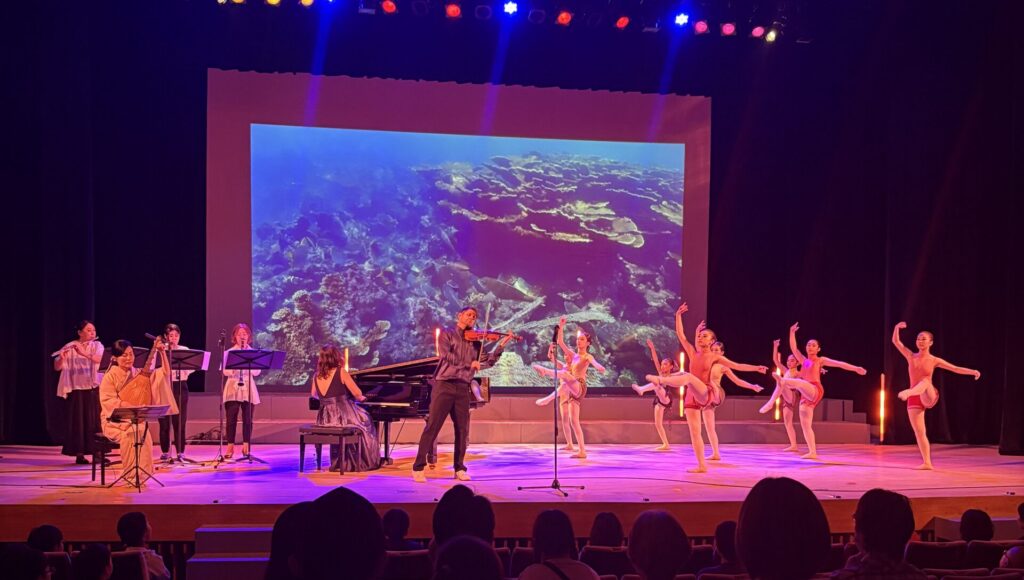
In Fukuchiyama, Ryoutan Nichinichi Shimbun covered the Music for the Ocean visit to Oe Gakuen, where Chad Cannon and Hui Wu performed for students and Juli Berwald spoke about ocean environmental issues. The article highlighted music inspired by coral spawning, tuna migration, and the team’s diving experience in Kyotango.
Read the Ryoutan article: https://www.ryoutan.co.jp/articles/2026/07/98918/
Fukuchiyama Seibi High School also shared a post about a special session with Chad, Hui, and Juli. The visit included a collaboration with the school wind ensemble and gave students a chance to hear more about the stories behind the music. Touei Junior High School also shared a reflection after students attended the performance, describing how powerful and memorable the experience was for the student musicians.
Read the Seibi High School post: https://www.seibi-hs.jp/sp/promotion/1/blog_detail.html?key=entry&value=505
Read the Touei Junior High School post: https://www.kyoto-be.ne.jp/touei-jhs/cms/?p=20523
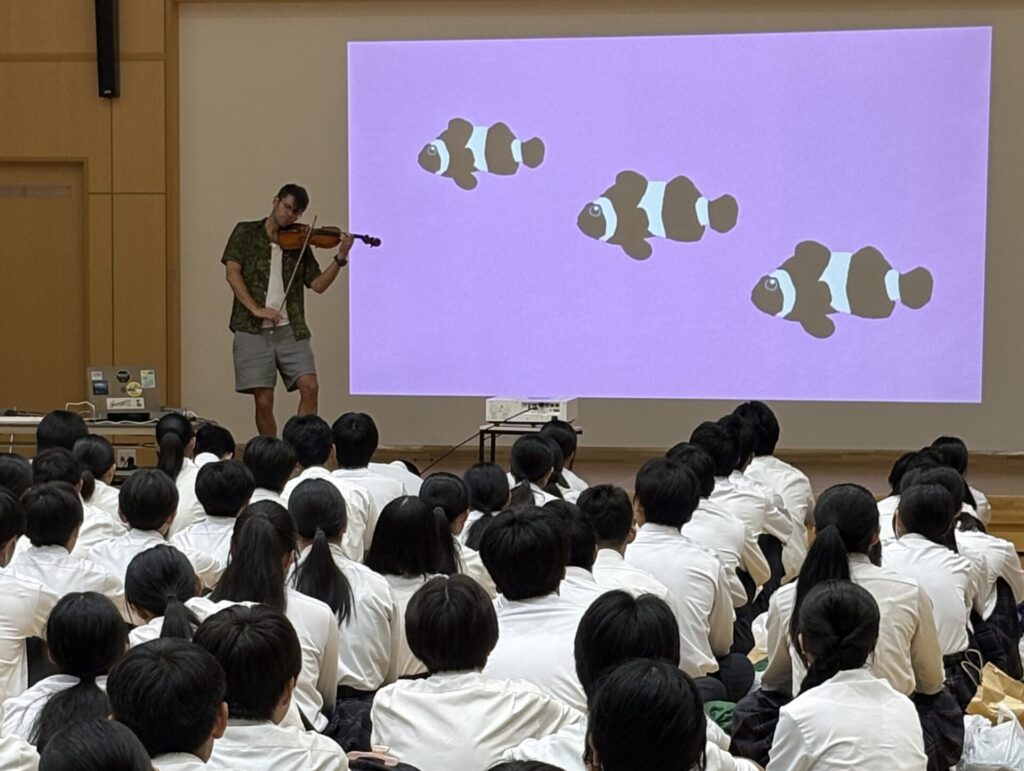
The tour also visited Takamori Senior High School and Midori Junior High School. Their school website shared a post about the July 8 program, which brought together marine science, music, and conversations about the ocean environment.
Read the Takamori school post: https://www.takamori-h.ysn21.jp/新着情報
Music for the Ocean was also covered by FNN and Tokai TV in Nagoya as an international concert project centered on ocean conservation and original music inspired by the sea. There was additional Kyoto-area coverage from Mainichi and Kyoto Shimbun about the tour’s school visits and performances.
Read the FNN article: https://www.fnn.jp/articles/-/1077752
Read the Tokai TV article: https://www.tokai-tv.com/tokainews/feature/article_20260718_47309
Read the Yahoo version: https://news.yahoo.co.jp/articles/d39a485c0aa033703fe7a6b639bef16b4f7a529c
Mainichi article: https://mainichi.jp/articles/20260717/ddl/k26/200/146000c
Kyoto Shimbun article: https://www.kyoto-np.co.jp/articles/-/1754972
While Music for the Ocean was sharing reef stories in Japan, Tela Coral’s work in Honduras was also in the news. La Prensa published a story about the coral biobank being built in Tela, describing it as the largest coral biobank in Mesoamerica. That piece brings the tour back to the heart of Tela Coral’s mission. Music for the Ocean helps people feel the wonder of the sea, while Tela Coral works to protect the rare and resilient reefs of Tela Bay.
Read the La Prensa article: https://www.laprensa.hn/honduras/tela-biobanco-genetico-corales-caribe-titulos-a-b-FG31371217
Finally, a special feature about Tela’s corals ran in CHUNICHI SHIMBUN/ the TOKYO SHIMBUN. The author of the piece, Yoshiko Takeda met with us for lunch in Nagoya and later joined for the concert. He was kind enough to send a translation, as well as the original laid out for the paper.
“The impact of the extreme heat wave appears to be reaching even into the ocean.
More than half of the world’s corals have been lost over the past 30 years, largely due to rising sea temperatures,” says Juli Berwald, 58, a marine biologist working to establish a coral gene bank and research facilities in Tela Bay, Honduras.
I met Berwald this July when she visited Japan to exhort supports for her projects. While about 80 percent of the coral reefs in the Caribbean Sea have perished, many endangered coral in Tela Bay miraculously survived. “This area could be the key to the ocean’s recovery once environmental conditions improve,” she believes.
Although coral reefs cover less than 1 percent of the world’s ocean floor, they are home to an estimated 25 percent of all marine life. After diving in waters across Japan during her trip, Berwald noted, “I felt that Japan still has rich coral reefs and fertile oceans filled with great potential.” She expressed hope that “more people will realize their importance and take action to protect them.”

The link to the article is here: https://www.chunichi.co.jp/article/1289753
We are so grateful to the students, teachers, journalists, musicians, organizers, audiences, and local communities who helped carry Music for the Ocean across Japan.
Thank you for listening, sharing, asking questions, and helping these ocean stories travel even farther.